Showing posts with label Rants. Show all posts

Tuesday, 13 April 2010

The evils of the iPhone

As my friends will doubtless be able to testify to I am a big fan of the iPhone. Being a fan of the iPhone often leaves one open to accusations of being a fanboy who has been duped into buying something that is over-hyped, and of course inevitably leads to lectures on the evils of the iPhone. Here are the common arguments, and my answers to them.


1. "The iPhone doesn't run flash."

Only people who don't own an iPhone seem to think this is a problem. I guess if you wanted to access video sites like YouTube, Veoh, BBC iPlayer... oh wait, no, those all work on the iPhone, either through a free app or a non-flash mobile page.

There are flash games on the internet, true, but by the nature of flash none of those are really designed for a touch screen interface or to be viewed on a mobile phone screen anyway. Why not just spend 50p on a decent game that actually fits the screen and uses the phone's accelerometers and multi-touch interface? There are also free games in the app store if you don't mind the odd advert - just like flash game websites.

After videos and games the only thing left is those annoying flickering adverts. Oh no! My phone browser won't display them!

Flash is not an open standard anyway, it is closed and owned by Adobe. The iPhone does support and run all the common open standards for video and other web content like MPEG, Java, HTML5, etc. It is in Apple's interest, as a minority player in computing, to promote such universal standards.

2. "The iPhone is chained to iTunes."

I think the iPhone is best thought of as an iPod that's also a phone. This is because all of the data resides on the parent computer, and is synchronized when the phone is connected to it. This makes it very easy to choose what content is on the phone and automates the whole process. Music (with cover artwork), video, pictures, applications, calendars, contact details, notes, basically everything on the phone, is backed up and copied across with minimal effort.

There are some huge advantages to this philosophy. For example, new podcast episodes are automatically added and old ones deleted. If you lose or wipe your phone you haven't lost your data.

Software updates also come through iTunes and are installed with just a click.

In my opinion the iTunes connection is a good thing.

3. "There's no way to manage files on the iPhone."

You don't have to manage files on the iPhone because everything is done automatically; this saves hours of faffing. Why do you want to waste your time pushing all your jpegs and mp3s around into folders? With the iPhone you just tick what folders you want to sync in iTunes and press go.

4. "But I want to use my phone as a mobile disk. The iPhone is useless because it won't let me do that."

Okay, so you want to carry around a USB cable around with you just in case you want to plug your phone into any computer you want to get files off? What's wrong with a flash memory stick? I have one, cost me £20, very small, lives in my wallet. Much easier.

5. "The iPhone has no removable storage."

I have had had several phones with removable storage cards. Such phones inevitably come with cheap, low capacity, memory cards which admittedly makes the phone seem cheaper to buy. Having subsequently bought a high capacity card for such phones I have never once changed the card from then on - because all the phone's files are on it! I do not not know anybody who has changed cards in mid use.

Most anti-iPhoners argue that they want "the option" to remove the storage. Most do not use this option on their existing phones where it does exist, and those that do are a tiny minority of phone users.

The iPhone's memory is built in and cannot be changed. This means that there is no confusion as to where, say, application and music files are. The easy sync with iTunes wouldn't work if the phone's memory could be changed during use, so I think losing the ability to remove the storage is quite an acceptable tradeoff.

6. "The iPhone has no removable battery."

The iPhone's battery is built in and cannot be removed. Here, again, we are into the "I want the option" territory. I have been told by people that they want "the option" to pop a couple of spare batteries in their bag if they're going on holiday - presumably to antarctica where there are no wall or car cigarette lighter sockets.

I have never met anybody who owns spare batteries for their phone, or indeed carries around spare phone batteries with them. I certainly never have either. It's an option that nobody ever really uses. Don't forget that making things like batteries and memory removable also requires infrastructure inside the phone making it heavier and bulkier for the same level of performance. In my opinion Apple have made a good tradeoff.

For that tiny minority of people who do want to be able to top up their phone on the go there are relatively compact external battery packs available for the iPhone that will charge it up again several times. Apple, or several 3rd parties, also offer the service of replacing worn out internal batteries if that's ever needed.

7. "The iPhone cannot multitask."

Every iPhone from day one has been able to multitask. The OS is constantly managing wireless connections, checking email, running alarms, calendars, etc. It can also play the iPod app's music in the background. What's that if not multitasking?!

What anti-iPhoners mean when they say the iPhone "can't multitask" is that up until now the iPhone has been unable to run multiple third party applications concurrently. The trouble with running multiple applications at the same time on a phone is that it runs the battery down very quickly and can impact on performance of the foreground application. Multitasking is easy to implement but it's very difficult to do this well.

Apple's solution until now has been to restrict the phone to running one 3rd party application at a time - there is, after all, only one small screen anyway. iPhone OS4, which will be released this summer, will allow 3rd party apps to run in the background and in a much more efficient way than on any other phone operating system. We will then hopefully cease to hear whinging about the iPhone's lack of true multitasking.

8. "But I want to run a messenger app or facebook in the background."

Apple's solution to the most common multitasking problem, ie wanting to have something like MSN or facebook in the background, is actually a much more elegant solution than simply running the app on the phone.

Run a messanger app or facebook feed application on a phone that does support multitasking and that application will be running on the phone, periodically contacting the server to see if there's new information. This all uses power.

The iPhone has something called the "push notification server", which is provided by Apple as part of the app store and doesn't require any tinkering to set up. It is possible to close the messenger app on the phone completely, whilst instead the server, not the phone, stays logged in to the messenger service. If anyone sends a message to the user, the server receives it and then pushes it as a notification to the phone telling the user that there is a message waiting. The user then fires up the messenger app, which takes all of about 2 seconds, reads the full message, and can answer. This means the user can be online continuously with barely any use of power or processing power. I think it's a much better way of doing things!

9. "The iPhone is expensive."

Fair. You get what you pay for though. It's not much more expensive than the Google Android equivalent phones - the Nexus One or HTC desire, especially after you've also bought a sensibly sized memory card.

10. "The iPhone will only take applications from the Apple app store. This is a bad thing and kills bunnies."

Yes, without jailbreaking at least, the iPhone will only run applications from the app store. This restricts the unfortunate iPhone user to the mere 185,000 apps that Apple have approved.

There are plenty of good things about the app store. It is a highly effective distribution system that allows professional and amateur application developers to write and distribute software easily and get paid for their efforts. It also means that theoretically none of the programs that one can legitimately download and run on an iPhone is going to do anything Malicious as they've all been checked and approved.

Perhaps in principle Apple's monopoly of iPhone software through the app store is not 100% good and perhaps in time users will be able to get iPhone software from other sources. This is not, however, an issue that manifests itself to the man in a street holding an iPhone.

10. "The iPhone is made by Apple. Apple = bad."

This is really the usual argument being put forward, if under the guise of one or more of the above, and the most likely reason why any true anti-iPhoner will not be swayed by what I've written.

Apple = bad. Playing in a loop inside their heads.

This is why, to them, the iPhone is a totally flawed concept, but the Nexus One or HTC desire are the best thing since sliced bread. (Err, it's the same form factor and the same interface guys!)

Apple are a company. They are interested in selling their products and increasing their market share. So are Microsoft, Google, Adobe, Dell, HTC and indeed any other company that makes computer software or hardware. Any company behaves in ways that are both "good" and "bad" to the outsider's eyes. What really matters is what the product does and how well it does it.

Apple believe in vertical integration - their software running on their hardware - and they believe in selling products that are of the best quality and targeted at the average user, priced accordingly. That's their niche in the market. If their products are "locked down" it's not out of some huge conspiracy it's simply because doing so makes them more suited to the people they are designed for.

These conspiracy theories are often wild and illogical anyway. For example I've heard people claim that Apple are "anti-developer", which is presumably why the full suite of software development tools for OS.X and iPhone are available for free from their website!

The average motorist doesn't want to have to strip down and clean their engine very 1,000 miles. That's the final word here; the iPhone isn't designed for a geeky minority who enjoy opening up the bonnet and tinkering with every aspect of their techno-toys, it is designed for the majority of users who want something that does awesome things without that fuss.

In conclusion

There is no doubt that the iPhone was and still is a game changing device. It has set the bar for a new generation of smart phones and brought many new technologies to the marketplace. I am glad that there are imitators like the Nexus One out there because it provides the incentive for Apple to innovate as they continue to evolve the iPhone concept.

There are many myths about the iPhone perpetuated by a very small but vocal minority of technophiles, mostly born from the discord stemming from the fact that the iPhone isn't really designed for them. This wouldn't be a problem if it wasn't for the way in which people who are not hugely technologically savvy will tend to listen to such people and, whilst not understanding the myths, get a bad feeling about the iPhone and be discouraged from getting something that is incredibly sound and better suited to them.

At the end of the day the iPhone is a superb, highly capable, easy to use, and incredibly reliable device. I wish that the nay-sayers would at least acknowledge that, even if they don't think it is for them, but I guess that's just wishful thinking on my part.

Friday, 12 March 2010

High speed rail myths

Yesterday the government released its plans for High Speed 2, the next high speed rail line to be built in the UK, following on from High Speed 1, the new line from London to the Channel Tunnel.

Reading the reception in the press there are certain common themes that come up in comments to it, many of which lead one to doubt the intelligence of the reporter writing it, or at least whether they have actually bothered to research the topic they are writing about at all.

Here are a few pearls of reporterly wisdom that I have found particularly irritating, and my answers to them.

1. "Spending £X billion to save 30 minutes isn't a good use of money."
The main driver behind high speed rail in the UK is transport network capacity. We have a choice between building or expanding motorways, expanding airports, or building railways. Yes HSR trains are fast, but they are preferable to conventional speed rail because there is a much better business case for faster trains. They are more likely to attract travelers from other modes of transport.

2. "HS2 only goes to Birmingham."
Yes, in phase 1 HS2 only goes to Birmingham. Guess what, phase 1 of the M1 motorway only went from Watford to Rugby. There are two points here: Firstly the trains on HS2 will be able to run on to serve other destinations beyond the end of high speed line such as Manchester, Liverpool and Scotland. Secondly it's important to see HS2 as the first stage of a broader UK-wide network.

3. "Nobody will be able to afford a ticket."
I've no idea where this particular pocket of nonesense comes from. Perhaps this is because of the current high cost of tickets on routes like the West Coast Main Line where capacity problems lead to operators trying to manage excessive demand by increasing the cost of flexible tickets. Each train on HS2 will have up to over 1,000 seats and the line will have capacity for 18 trains an hour; that's a lot of seats! Tickets will be priced such that people use the service and fill those seats, otherwise the business plan wouldn't be viable in the first place.

4. "HS2 does nothing for communities between Birmingham and London."
No, it does a lot for communities between. Principally it releases an enormous amount of capacity on the overstretched existing rail network such as the West Coast Main Line, which can be used for freight - fewer lorries on the roads - and also for more local rail services.

5. "£30 Billion is too expensive."
£30 Billion is a lot of money, but the greater cost comes from not acting on the nation's increasing transport problems. As already states we have a choice between roads, air and rail. High speed rail is the best choice from both economic and environmental perspectives.

6. "Can't that money be spent on improving the trains we already have?"
£13 Billion has been spent in the West Coast Main Line upgrade program, and it will be at full capacity again by 2017. Incremental upgrades to existing rail lines are expensive, disruptive, and do not produce anywhere near the same levels of new capacity for the same amount of money as a new build line.

7. "We can't afford this in a recession."
Recessions come and go. We're in recession now, but most likely won't be when construction work actually starts in a few years time.

8. Why will it take 16 years to open just 130 miles of railway track? Surely it would take only a fraction of that time if this line was being built in France, Span, Germany, Italy, Japan, Korea, Taiwan, China, etc?
Oh, hang on, this is a question I too would like an answer to...

Thursday, 25 February 2010

Renting

Rosie and I are coming up on the time for us to move out of the flat, and this has reminded me of just how much I hate renting.

The first thing that irritates me is that I have to rent at all. I am fortunate in being better off than most people; I am a young professional earning a good wage that is already well above the national average, but it's just not enough. The problem is the way in which house prices in this country are simply sky high, they are just out of reach for any young person trying to get a first tenuous foot on the ladder. It's not even as though you get much for your money either; the first floor of a modern £180,000 house would probably fit into one of the bedrooms of my parents victorian-era home.

So there is no sensible choice available to me but to rent, especially as Rosie is now living with me.

The main reason I dislike renting is landlords.

This dislike isn't a personal dislike; indeed I've liked most of the individuals who have been my landlord or landlady in the past, but I really dislike the relationship with them.

One reason that it is so impossible to find housing that is within the range of affordablity to a well paid graduate engineer is the demand on housing, and in particular the buy-to-let phenomenon. This is a where the landlord, usually an older individual with enough clout to get a second mortgage, can buy a property and then sit back and relax whilst the tenant labours away paying off their mortgage for them. The tenant's crime, the thing that condemns them to rent and not own? Just not wealthy enough to begin with. It's as though the system is structured (through cock-up rather than conspiracy) to ensure that the underdog or newcomer has no chance, whilst the rich get richer.

Hooray for the free market. Nice to know that our supposedly Labour government is pushing the progressive agenda on which it is allegedly founded. A tax on buy-to-let properties to redress the balance and make it easier for newcomers to get on the ladder? Don't be silly!

All this leads to the worst thing about renting and landlords, which is this. Every Landlord has to have their own oddball fetish over something that needs to be cleaned beyond sensible possibility, and this becomes a particular sticking point when the time comes to move out.

My landlord in Southampton had a particular thing about the caulking around the shower and the fact that there was mould growing in it. This is what tends to happen with old bathroom caulking of course, but that wasn't good enough for him, we would have to get it out with bleach, or else pay for it to be re-caulked. Of course the bleach didn't make the blindest bit of difference, but at least in that instance the landlord seemed to forget and my housemates and I didn't end up pay for his caulking fetish.

The first flat I rented on my own after university was furnished. My landlord and landlady did an inspection and during this decided to inform me that the desk was showing signs that I'd put things on it. Apparently this was not on because it was an antique, and thus it needed professionally re-varnishing. I wasn't able to get out of meeting that particular whim.

Rosie holds the record for the best landlord's fetish anecdote though. She had a landlady who wanted to get the carpets professionally cleaned. Which was a bit of an odd priority to have considering there was a HOLE IN THE ROOF letting in water whenever it rained!

The latest gem that Rosie and I face, and what prompted this rant, is that our current landlady wants the cooker professionally cleaned, because it was apparently professionally cleaned before I moved in. Likewise the curtains, which were new when I moved in.

Did I mention,the bloody cooker IS clean, the bloody curtains ARE clean. The only difference if I got in a "professional" would be a little piece of paper saying how much of my money they've pocketed.

Landlords seem to like to string tenants up by the petard of their deposit and indulge themselves in a game of selective implausible perfectionism on a whim.

Leave me alone! It's partly due to speculators like you that I can't be putting my own money into a mortgage of my own! I've paid 21 months' worth of your mortgage and taken good care of your property, isn't that enough?!

Friday, 21 August 2009

...and another thing!

Whilst I'm ranting about the RAC, I'll post another link to this.

Basically it's another demonstration of how they are able to, by choosing the numbers that represent only a small part of the picture, suggest that a great injustice is being done to motorists.

Who are these "motorists" anyway, are they a separate species? Are we not all just human beings trying to get from A to B using the best method made available to us?

Anyway, they will argue that the BCR, or "Benefit-Cost ratio" of road schemes is much higher than for public transport schemes, thus the money should be spent on roads.

They quote average BCRs for different types of projects undertaken:

  • Highways Agency Roads - 4.66
  • Local roads - 4.23
  • Heavy rail schemes - 2.83
  • Light rail schemes - 2.14
  • Local public transport schemes - 1.71
This might seem the obvious course of action, but for a couple of showstoppers for this kind of numbers-based argument.

First, road schemes never include the cost of vehicles in the calculations, because the user pays for them directly. This makes road schemes appear cheaper when in fact on an overall cost per user basis they are much more expensive.

Secondly, and most significantly, fuel duty is included in the calculations. This means that any analysis using this set of criteria will come out in favour of a scheme that puts more cars on the roads. Light rail schemes, for example, which are designed to reduce congestion by attracting motorists out of their cars, have to gain a high enough benefit cost ratio to get approval despite the loss of income to the treasury from fuel duty counting against them.

Numbers can be useful, but they should always be viewed in context.

Tuesday, 14 April 2009

Curious behaviour

I am becoming increasingly convinced that for a lot of people when they get behind the wheel of a car and they switch on the engine, they are also switching off their brain.

Yesterday I went for another bike ride, another forray around my 50-mile circuit, and I saw a very interesting example of the way in which the minds of many motorists work. It didn't annoy me, I merely found it illustrative and amusing.

About half way around my circuit I was riding my bike down a hill toward a village, at a speed between 35/40mph. The road was quite narrow, and to be honest I don't think I would have been taking it any faster if I'd been in a car.

As I entered the village I applied my brakes to slow down to 30mph. This was for the sake of sanity rather than the law; the speed limit signs I passed don't apply to bicycles. Several seconds after passing the signs I was aware of a vehicle behind me, and given my speed I was quite surprised when a silver 4x4 roared past me, probably doing at least 40mph. I was even more surprised when, imediately having passed me, the driver tucked back in to the left and applied his brakes sharply to also drop to 30mph. I nearly had to brake myself to avoid running into the back of him!

I see this behaviour is indicative of the kind of uncritical thinking that is typical of many motorists. I have been a driver myself for many years and I am convinced that had I instead been in a car travelling at exactly the same speed this motorist would not have behaved in the same way.

Put a cyclist in front of many motorist and it becomes imperative for them to overtake, to get past. Indeed this can be so single minded in nature that other factors such as the actual speed of the bicycle, or an upcoming red light, or stationary traffic ahead are often completely ignored.

One of the most valuable lessons I have learned as a cyclist is to get into the mentality that when I am riding a bicycle on the road I am driving a vehicle, and to behave as such.

Unfortunately not everybody who uses the roads sees it that way.

Sunday, 29 March 2009

Time zones

Ahh, once again it's that time of year when some helpful individual in the past decided that we should all move our clocks an hour forward... or is it back? I forget. Just like I always forget exactly which weekend it is.

This isn't helped by the way in which my growing older has coincided with the acquisition of more clocks. A clock in each room, a clock in my car, my watch, etc etc. I have to go around and change them all.

I just think this is really silly. It doesn't change the amount of daylight available, so if some proponent of daylight saving time is so keen on making use of the daylight in the early morning in the summer may I suggest they just get up earlier? Making the rest of us faff about with all of our time pieces twice a year is not helpful at all.

What would I like? I would like this country to choose which bloody timezone it wants to be in and stick to it.

Rant ends.

Thursday, 18 December 2008

Sandwiches

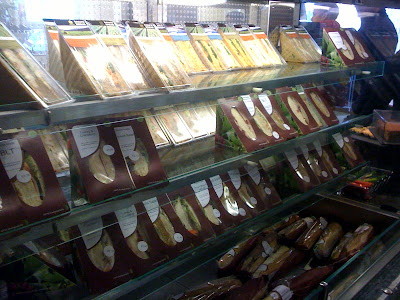
It has been apparent to me for a long time that we have a disease in this country and that disease relates to sandwich fillings.


Somewhere, surely, there must be people who hold the executive power to decide what should be put in the sandwiches that are put into packets for sale at sandwich counters, and it seems to me that these individuals are on a lifelong quest to make all sandwiches everywhere what they would consider to be as interesting as possible.

I don't consider myself to be a fussy eater, I will generally eat most things, but some of the sandwich filling combinations that these people come up really leave me questioning that idea. As I see it the more different ingredients that go into a sandwich, the greater the chance that one of those ingredients will make the whole sandwich a non-starter, by being something I'm not particularly keen on, or something I don't believe should be in a sandwich, or I feel it clashes with something else.

Do 80% of people really want a salad in their sandwich for example? Has anyone asked them?

There's always mayonnaise too. Why, why, why make the assumption that nobody wants margarine or butter on their sandwich, but everybody loves mayonnaise and lots of it?!

The result is I often find myself, stomach growling, looking at a whole shelf stacked high with sandwiches hoping against hope that I can find just one sandwich that doesn't make the corners of my mouth instinctively curl downward.

All I want is to be able to reliably be able to buy a nice simple sandwich like cheese and ham, or tuna, bacon, chicken or turkey with stuffing maybe even. Without mayonnaise. The trouble is that if the sandwichmakers' cartel do let their guard down and allow the occasional couple of simple sandwiches to sneak onto the shelves these always disappear almost instantly, the label remaining below the empty space of course to add insult to injury.

Market economics would seem to suggest that perhaps, maybe, this would be a sign that perhaps there is more demand for such "boring" sandwiches and that maybe they should make more of these, and fewer of the other type, which go on to form the unclaimed hoards, remaining to be eyed with suspicion by hungry passers by.

Unfortunately this isn't the case. As far as I am able to tell, to the unpopularity of their more interesting sandwiches can only be interpreted by these people as a signal that they aren't trying hard enough, and they'd better redouble their efforts next time around. This then becomes an endless feedback loop which will go on forever.

If it wasn't for the time spent travelling I swear it would be worth the price of a Eurostar ticket to go to France where it's possible to get a buttered baguette with cheese and ham in it. Delicious cheese and ham, and nothing else!